EUROGRAPHICS 2026 |
| |
| Splat-based Metal Artifact Reduction in Cone-Beam CT via Polychromatic Modeling |
| Best Paper Award at Eurographics 2026 |
| |
| |
Kiseok Choi |
|
Inchul Kim |
|
Jaemin Cho |
|
| |
Hyeongjun Cho |
|
Min H. Kim |
|
| |
|
|
|
| |
KAIST |
|
| |
|
|
|
|
| |
 |
| |
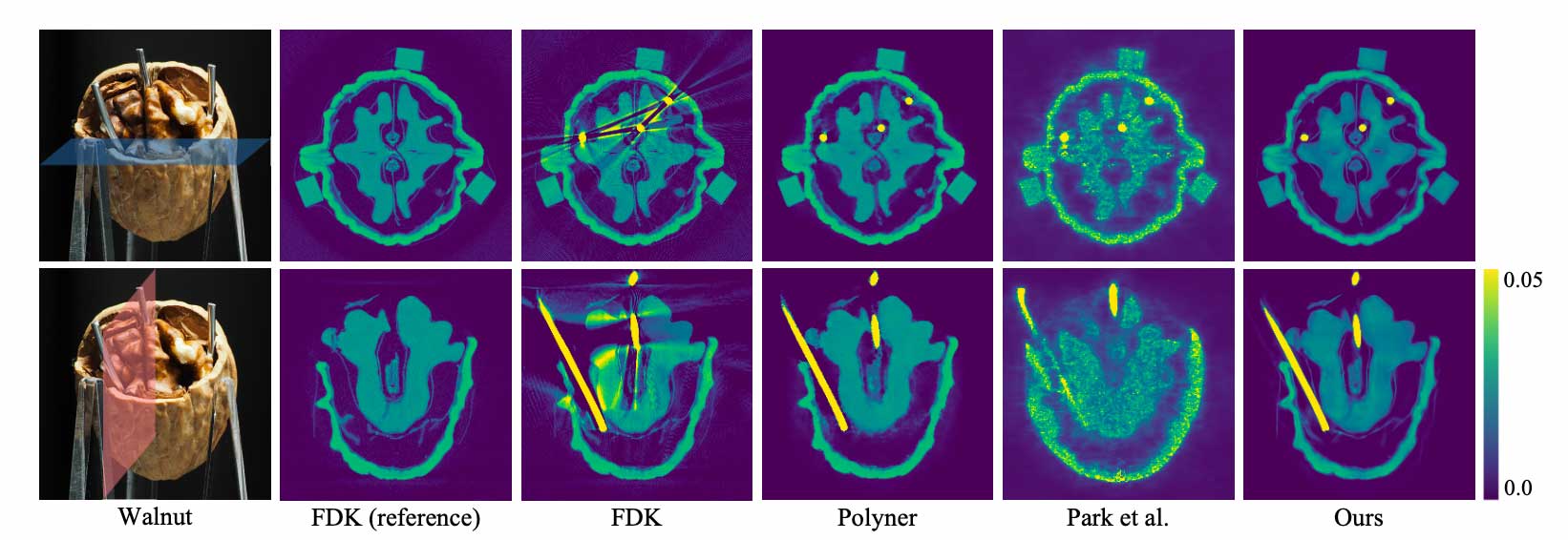
Qualitative comparison of CBCT reconstruction results for a real walnut object with inserted metal pins. The leftmost column shows the optical photograph of the walnut, where the blue and red planes denote the positions of the horizontal and vertical cuts for visualization. Each reconstruction method is visualized with two slices: a horizontal slice (top row) and a vertical slice (bottom row) from the reconstructed volume. The FDK (reference) result corresponds to a baseline scan of the walnut without metal pins and serves as a ground-truth proxy free from metal artifacts. FDK applied to the metal-inserted scan exhibits severe beam hardening artifacts, including dark streaks and intensity distortions. Polyner reduces some artifacts but shows noticeable blurring and oversmoothing of fine structures. Park et al. minimizes artifacts but considerably compromises the overall image structures, suffering from noise. Our method delivers the most faithful reconstruction by effectively suppressing artifacts while preserving structural detail in both axial and sagittal views, demonstrating its robustness for cone-beam CT with severe metal-induced beam hardening. |
|
| |
|
|
| |
|
|
| |
|
| |
Abstract |
| |
|
| |
Cone-beam computed tomography (CBCT) enables volumetric reconstruction from X-ray projections, but suffers from severe artifacts--especially beam hardening--when imaging materials with high attenuation such as metals. These artifacts arise from the polychromatic nature of X-rays and are not properly addressed by conventional monochromatic reconstruction algorithms. While recent neural representation-based methods offer improved reconstruction quality, they are computationally expensive and often impractical for deployment. We propose a novel physics-inspired, self-calibrating metal artifact reduction method that efficiently reconstructs 3D CBCT volumes while correcting beam hardening artifacts. Our method integrates a polychromatic X-ray projection model, material-dependent attenuation profiles, and system response modeling into a Gaussian Splatting framework. Unlike prior work, we eliminate the need for manual metal masks or strong prior assumptions, and we optimize both reconstruction parameters and X-ray spectral characteristics jointly during training. We further introduce a high-fidelity synthetic CBCT dataset generation pipeline validated on Monte-Carlo x-ray simulation toolbox and release new datasets with severe metal-induced artifacts to support the community. This is the first splat-based method for reducing beam hardening in CBCT. Extensive experiments on both synthetic and real-world datasets demonstrate that our method outperforms state-of-the-art approaches in artifact suppression and reconstruction accuracy.
|
| |
|
| |
|
| |
@Article{Choi:EG:2026,
  author  = {Kiseok Choi and Inchul Kim and Jaemin Cho and
             Hyeongjun Cho and Min H. Kim},
  title   = {Splat-based Metal Artifact Reduction in Cone-Beam CT
             via Polychromatic Modeling},
  journal = {Computer Graphics Forum (Proc. EUROGRAPHICS 2026)},
  year    = {2026},
  volume  = {45},
  number  = {2},
  pages   = {}
}
|
|
|
|
|
|
|
Hosted by Visual Computing Laboratory, School of Computing, KAIST.
|
 |
|