Splat-based Gradient-domain Fusion for Seamless View Transition
Dongyoung Choi
Jaemin Cho
Woohyun Kang
Hyunho Ha
James Tompkin
Min H. Kim
KAIST
Brown University
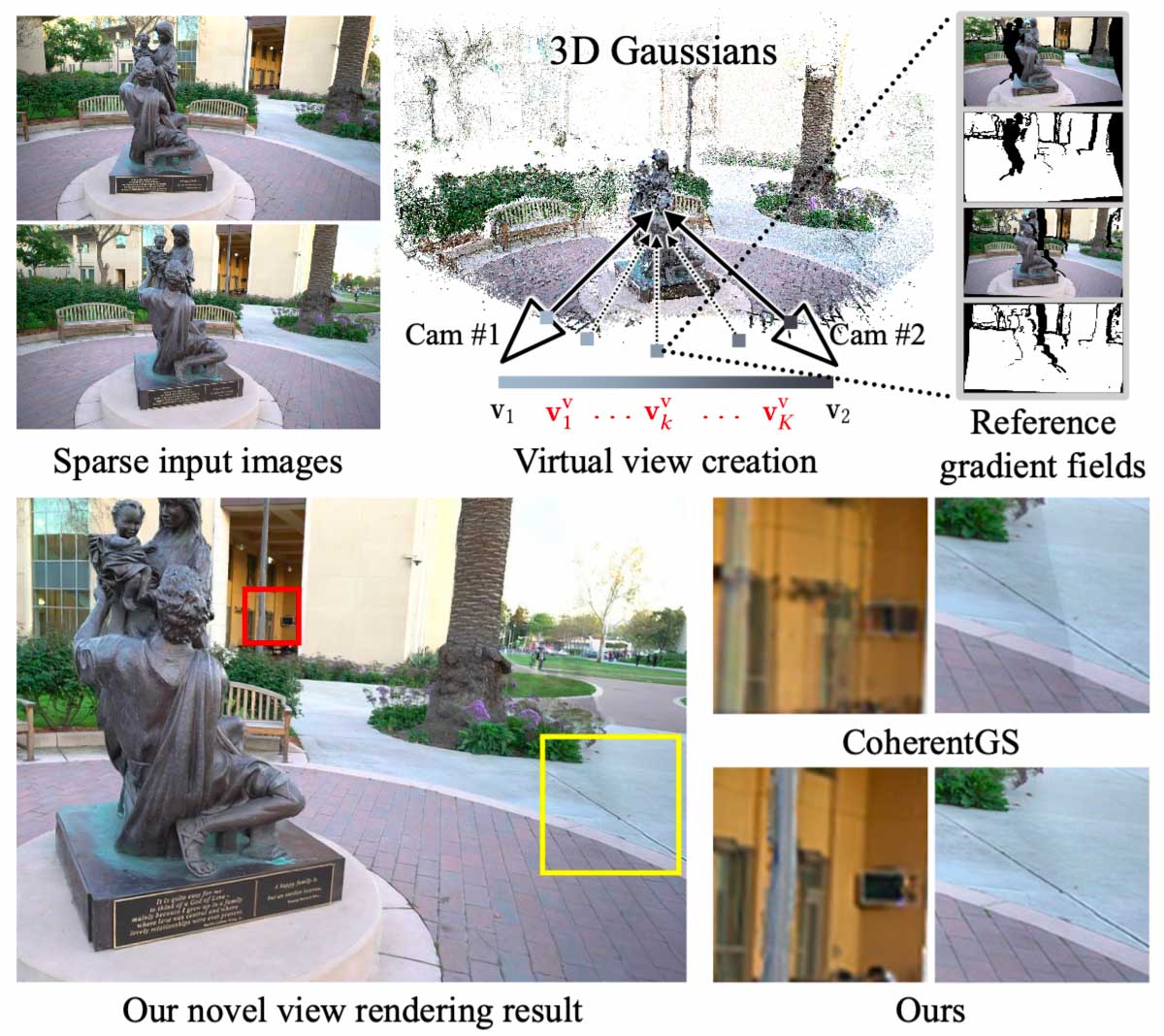
Alleviating overfitting in sparse settings for 3D Gaussian splatting. Given sparse input, Gaussians are adjusted to match specific input training views, resulting in unreliable geometry and inconsistent color appearance through novel view transitions. We integrates gradient-domain fusion (GF) of reprojected input views at intermediate virtual poses into the GS rendering framework. This creates reference gradient fields to regularize the rendered result, producing a smoother appearance variation during view transitions. Our method achieves higher-fidelity and perceptually pleasing view synthesis in sparse scenarios than existing work.
Supplemental video
Abstract
In sparse novel view synthesis with few input views and wide baselines, existing methods often fail due to weak geometric correspondences and view-dependent color inconsistencies. Splatting-based approaches can produce plausible results near training views, but they frequently overfit and struggle to maintain smooth, realistic appearance transitions in novel viewpoints. We introduce a splat-based gradient-domain fusion method that addresses these limitations. Our approach first establishes reliable dense geometry via two-view stereo for stable initialization. We then generate intermediate virtual views by reprojecting input images, which provide reference gradient fields for gradient-domain fusion. By blending these gradients, our method transfers low-frequency, view-dependent colors to the rendered Gaussians, producing seamless appearance transitions across views. Extensive experiments show that our approach consistently outperforms state-of-the-art sparse Gaussian splatting methods, delivering robust and perceptually plausible view synthesis. A comprehensive user study further confirms that our results are perceptually preferred, with significantly smoother and more realistic color transitions than existing methods.
BibTeX
@InProceedings{Choi:3DV:2026,
  author  = {Dongyoung Choi and Jaemin Cho and
             Woohyun Kang and Hyunho Ha and James Tompkin
             and Min H. Kim},
  title   = {Splat-based Gradient-domain Fusion
             for Seamless View Transition},
  booktitle = {Proc. Int. Conf. 3D Vision (2026)},
  address = {Vancouver, BC, Canada},
  year = {2026},
  month = {03},
}